

 Socious Report
 Socious Work
 Socious Verify
Switzerland in 2026: The Climate Ordinance You Report Under Is Still the One From 2024
If you report in Switzerland and you have been waiting for the ISSB alignment, stop waiting. It was consulted on, broadly welcomed, and then paused. For the financial year 2026 the rules are the ones that entered into force on 1 January 2024.
That is worth saying plainly, because Switzerland currently has two live workstreams with similar names, one paused ordinance, one bill in consultation, and a third instrument whose title differs by a single word. Mixing them up is easy and expensive.
The ordinance, and what happened to its revision
The Verordnung über die Klimaberichterstattung entered into force on 1 January 2024. It sits under the non-financial reporting duty in Articles 964a to 964c of the Code of Obligations and is built on the TCFD recommendations.
On 6 December 2024 the Federal Council put a revision out to consultation. The idea was to let companies satisfy the ordinance by reporting under an international standard instead, with ISSB and the European ESRS the obvious candidates.
On 21 March 2025 the Federal Council took note of the results and asked the justice department to work up options for a pragmatic revision of the Code of Obligations provisions themselves.
Then, on 25 June 2025, it stopped. The decision is in the Federal Council’s own release: it decided “die Revision der Verordnung zur Klimaberichterstattung von Firmen vorläufig zu pausieren” (SIF, 25.06.2025).
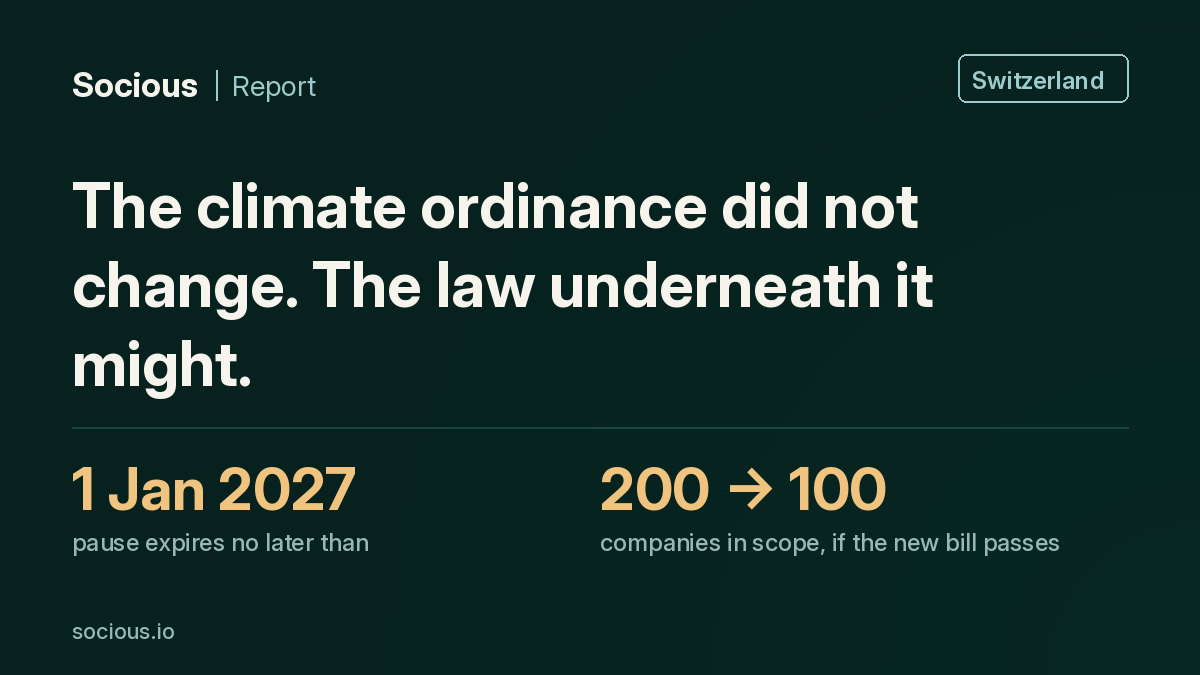
The reason is not that the revision was unpopular. The same release records that the consultation welcomed it on the substance, “wurde die Revision inhaltlich zwar mehrheitlich begrüsst”, and that respondents broadly asked to wait with implementation until the parent law had been settled. The pause runs until there is clarity on the Code of Obligations changes and on regulatory developments in the European Union, and in any case no later than 1 January 2027, “spätestens jedoch bis zum 1. Januar 2027”.
So the ordinance stands as written. The option to report under ISSB or ESRS in place of it has not entered into force.
There is a consolation in the detail, and it is the reason the pause costs less than it reads. The ordinance is built on the TCFD recommendations, and IFRS S2 incorporates those same recommendations as its backbone. A Swiss report assembled properly under the current ordinance therefore already carries most of the content an S2 report needs: governance, strategy, risk management, and metrics and targets, against climate-related risks and opportunities. What an eventual ISSB alignment would mostly add is rigour about where the numbers come from, not a new set of questions.
That matters for sequencing. A team that treats the 2026 report as a holding exercise will have to rebuild when the pause lifts. A team that builds the FY2026 report as if S2 were already in force produces a compliant Swiss report today and absorbs the change later as a formatting job.
The bill that would halve the population
On 1 April 2026 the Federal Council opened consultation on a new Federal Act on Sustainable Corporate Governance, as an indirect counter-proposal to the popular initiative of the same name, which it rejects. The consultation ran until 9 July 2026 (Federal Council, 02.04.2026).
Three things in it change the shape of Swiss reporting.
The duty survives. The Federal Council states it wants to keep it: “An der Pflicht zur Nachhaltigkeitsberichterstattung will der Bundesrat festhalten.”
The population shrinks. Only large companies would be covered, which the release quantifies as “rund 100 statt den aktuell 200 Unternehmen”, about 100 instead of the roughly 200 today. The release gives no numeric size thresholds, and says small and medium-sized companies are not directly affected.
Assurance becomes mandatory for those who remain. Covered companies would have to have their reporting checked by an external audit firm. Today the Swiss regime has no general assurance requirement, so for the companies still in scope this is the larger change of the two.
Separately, human rights and environmental due diligence would apply to around 30 large companies, where today the duty is limited to child labour and conflict minerals risks.
The release does not mention the climate ordinance at all. The two tracks remain separate, and the ordinance’s pause is tied to the Code of Obligations decision rather than to this bill’s outcome.
The instrument that is not this one
In the same period the Federal Council adopted amendments to the Klimaschutz-Verordnung on 9 September 2026, in force from 1 November 2026.
That is a different instrument. It concerns the federal administration’s own emissions, not corporate reporting. The names are one word apart, the dates are close together, and a search for recent Swiss climate ordinance news returns both. Checking which one a source is describing takes ten seconds and has caught more than one confident summary.
What a reporting team should actually do
For the financial year 2026, assume no change. Report under Articles 964a to 964c and the climate ordinance as it has stood since January 2024. Anything that assumes the ISSB option is live is working from a 2024 consultation draft.
Watch two dates rather than the news cycle. The ordinance pause expires no later than 1 January 2027. The Code of Obligations decision it waits on was due by spring 2026 and arrived as the bill above, which still has to pass consultation, a dispatch to Parliament, and Parliament itself. Nothing in that chain moves a reporting obligation before FY2027 at the earliest.
Do not plan to fall out of scope. A company in the group that drops from the 200 to the 100 loses a statutory filing. It does not lose the questions. Its EU customers still need its emissions for their own value chain disclosures, its banks still ask, and the data request from a Japanese or German parent arrives on the same schedule as before. The statutory duty is the smallest of the demands on the same dataset.
Three questions settle most of this faster than another regulatory summary. Can you produce the activity data behind any single emissions figure in your report, with its source document, inside a day? Do you know which emission factor version each figure used, and can you restate a prior year when a factor is revised? And if your largest customer asked for your Scope 1 and 2 in their template rather than yours, how long would that take? The third question is where most teams stall, and the cause is usually how the data is held rather than the template itself.
Build once, map many. Scope 1 and 2 at the required granularity, with activity data traceable to source and a documented methodology, answers the ordinance today, an ISSB-aligned regime if the pause lifts into one, and the customer requests that never stopped. The jurisdictions keep rearranging their labels. The underlying measurement does not change, which is why the teams that treat this as a data problem rather than a disclosure problem spend less each time a rule moves.
That is what Socious Report is built for: one dataset in, audit-ready reports out for CSRD, SSBJ and ISSB, and an independent Socious Verify credential on the result. If you want to see where your data sits against a framework before anything is due, the CSRD readiness check is free and takes a few minutes.